
Brownstone Restoration in Brooklyn, Harlem & NYC
Flaking stoops, crumbling sills, facades hidden under decades of failed cement patches — most of New York's brownstones are overdue for the right kind of care. Tekno Construction restores brownstone facades, stoops, lintels, sills and cornices across Brooklyn, Harlem, the Upper West Side and beyond — proper cutting back, compatible restoration mortar, color and texture matched to the original, and every city filing handled for you.
Free on-site brownstone assessment: (718) 772-8498 — or send photos of the flaking, the crumbling stoop or the failed patch on WhatsApp and we'll tell you honestly what you're looking at. Every inquiry gets a response within 24 hours.
Why brownstone fails
Brownstone is a soft, porous sandstone, quarried in the 1800s and laid as a veneer over brick — chosen because it was cheap to cut and beautiful to carve, not because it was durable. Much of it was bedded the wrong way, natural layers facing out, so a century of New York weather has been peeling them apart: water soaks in, freezes, expands, and the face delaminates one thin sheet at a time.
That's why nearly every brownstone in the city shows some combination of the same conditions:
- Spalling — the face of the stone flaking, blistering or breaking away in sheets and chunks, exposing the softer material underneath to even faster decay.
- Sugaring — the surface eroding into loose sandy grains you can brush off with a hand. The binder in the sandstone is failing, and the stone is literally turning back into sand.
- Cracked and hollow patches — earlier repairs done with hard cement stucco that never bonded properly. Tap them and they sound hollow; give them a few more winters and they let go.
- Failing details — window sills, door surrounds, band courses and cornice elements rounding off, cracking through or dropping fragments to the sidewalk below.
- Open joints and staining — failed mortar joints and copings letting water travel inside the wall, which accelerates everything else and shows up as damp interior walls no paint will cure.
None of this means the building is failing — the brick structure behind the brownstone is usually sound. It means the veneer needs restoration by someone who understands what the material actually is.
The cement smear problem
The most common brownstone repair in New York is also the one that guarantees the next failure: a thin smear of ordinary Portland cement troweled over the deteriorated face. Hard, dense cement doesn't move, breathe or weather the way soft sandstone does. Moisture gets trapped behind the patch, freeze-thaw cycles pry at the bond line, and the patch pops off — usually taking more of the original stone with it. Every failed gray patch you see on a brownstone block is this repair, aging on schedule.
Proper brownstone restoration is a different discipline entirely:
- Cutting back to sound material — deteriorated, sugaring and delaminating stone is carefully cut and chiseled back until we reach a solid, stable substrate. Patching over rot just buries the problem.
- Mechanical keying — the exposed surface is scored and cleaned so new material locks into the old, with anchoring where deep rebuilds of sills, brackets or carved details call for it.
- Compatible restoration mortar — purpose-made repair mortars formulated to match brownstone in softness, porosity and thermal movement, applied in layers to rebuild the profile. The repair must be slightly softer than the surrounding stone, so it weathers sacrificially instead of destroying its host.
- Color and texture matching — the finish coat is blended to match your building's particular shade of brown — no two blocks aged the same — then hand-tooled and textured so the repair reads as stone, not as a plastered-over scar. Where the whole facade is resurfaced, scoring recreates the original joint lines.
- Fixing the water first — copings, sills, joints and drainage details are corrected as part of the scope, because a beautiful restoration under a leaking parapet is a short-lived restoration. It's the same principle that drives our waterproofing work.
Stoops, lintels, sills and cornices
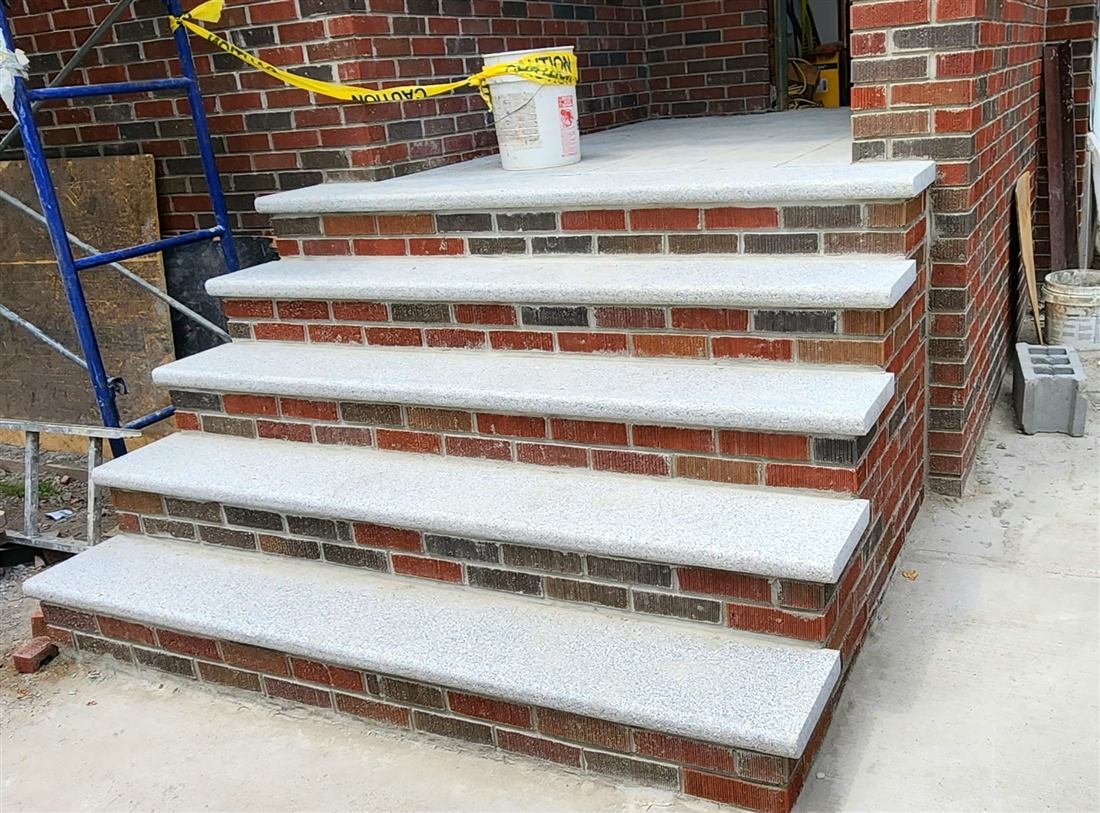
The stoop takes the worst of it — weather from above, salt from below, and daily use. Our stoop repair work across Brooklyn and Harlem runs from resurfacing worn treads and rebuilding crumbling cheek walls and newel posts to full stoop restoration where earlier patches have failed wholesale. Where decades of cement work have stripped a stoop of its detail, we rebuild the profiles — the curves, the moldings, the balustrade lines — so the entrance looks the way it was meant to.
Above the stoop, the same approach carries across the facade: sills and lintels cut back and rebuilt in compatible material, door surrounds and band courses re-profiled, cornice elements repaired or replicated. Where the underlying problem is structural — a rusted steel lintel jacking the masonry apart — our masonry and brickwork crews handle it in the same mobilization, so the facade is fixed once, completely.
Landmarks and the paperwork
Many of New York's brownstone blocks sit inside designated historic districts, where exterior work generally needs Landmarks Preservation Commission approval before it starts — and the LPC cares about exactly what a good restoration mason cares about anyway: appropriate materials, matching color and texture, true profiles. Outside the districts, facade work can still trigger DOB permits, sidewalk protection and inspections.
We handle the whole process with the city — confirming what applies to your building, preparing the filings, coordinating approvals and seeing the inspections through to sign-off. It's part of every job, never a separate task left to you.
Facade restoration beyond the brownstone
Brownstone work is one part of the broader facade restoration we do across NYC — limestone, cast stone, brick and terra cotta on pre-war buildings of every size, from single townhouses to full exterior restoration programs. On larger buildings, facade repairs are often driven by the engineer's Local Law 11 (FISP) report; we perform the repairs that close those reports out, coordinating directly with the engineer through sign-off. It's why the crews on your stoop know facades at every scale.
What determines brownstone restoration cost
No two brownstones weathered the same way, so we don't guess over the phone and we never publish flat rates. We visit your building free of charge, sound the facade up close, and hand you a fixed written quote — no obligation, and no revisions after the work starts.
Your price is determined by:
- Scope of deterioration — isolated patches and a stoop refresh price very differently than a full facade resurfacing
- Depth of repair — surface restoration vs. deep rebuilding of sills, brackets and carved detail
- Access — ladder work vs. scaffolding, and whether sidewalk protection is required
- Existing patchwork — removing failed cement repairs adds preparation before restoration can begin
- Detail and ornament — hand-tooled profiles, moldings and replicated ornament take skilled hours
- Approvals — Landmarks review and DOB filings where the building's location and scope require them
We respond within 24 hours and can usually schedule your visit the same week. Request your quote here.
Where we work
From our Yonkers headquarters we run restoration crews across all five boroughs and Westchester. The heart of this work is Brooklyn's brownstone belt — Park Slope, Bed-Stuy, Fort Greene, Clinton Hill, Crown Heights — plus Harlem, Hamilton Heights and the Upper West Side's row house blocks. If your street is lined with brown facades, we've almost certainly worked on one like yours.
Frequently asked questions
Why is my brownstone crumbling and flaking?
Because brownstone is a soft, porous sandstone, and much of it was installed with its natural layers facing the weather. Water soaks in, freezes and pries the layers apart — that's the flaking (spalling) — while the stone's natural binder slowly fails and the surface erodes into sand (sugaring). It's the material aging on schedule, and it's restorable when the repair respects what the stone actually is.
Can a brownstone facade be restored, or does it need to be replaced?
Almost always restored. The brick structure behind the brownstone veneer is usually sound; what fails is the stone face. Deteriorated material is cut back to a solid substrate and rebuilt with compatible restoration mortar, matched in color, texture and profile. Full stone replacement is rare and reserved for elements too far gone to rebuild — the free assessment tells you which you're looking at.
Why do cement patches on brownstone keep failing?
Because ordinary Portland cement is much harder and denser than the soft sandstone it's covering. It traps moisture behind the patch, refuses to move with the stone through freeze-thaw cycles, and eventually pops off — often taking original stone with it. Proper restoration uses purpose-made mortars that are slightly softer than the stone, so the repair weathers sacrificially instead of destroying its host.
Can you match the original brownstone color and texture?
Yes. The restoration mortar's finish coat is blended to match your building's particular shade — brownstones range from chocolate to reddish to nearly pink, and no two facades aged identically — then hand-tooled so the texture and joint lines read as stone. Matching is the difference between a restoration and a visible patch, and it's a standard part of our scope, not an upgrade.
Do I need Landmarks approval for brownstone restoration?
If your building sits in a designated historic district, exterior restoration generally needs Landmarks Preservation Commission approval before work starts. Outside the districts, facade work can still require DOB permits and sidewalk protection. We confirm exactly what applies to your building and handle the filings, approvals and inspections as part of every job.
How much does brownstone restoration cost in NYC?
It depends on how much of the facade has deteriorated, how deep the repairs go, access and sidewalk protection, how much failed patchwork must come off first, the amount of hand-tooled detail, and whether Landmarks or DOB filings apply — which is why we quote only after seeing the building. The on-site visit is free, the quote is fixed and in writing, and we respond within 24 hours.
Restoration by people who respect the stone
15 years, 500+ projects
Fifteen years of masonry and facade work across New York — over 500 completed projects, and a lot of failed cement patches replaced with restoration that actually holds.
Licensed & insured
A fully licensed and insured general contractor. Filings prepared under our license, approvals coordinated where the district requires them, inspections seen through to sign-off.
24-hour response
Every call, form and WhatsApp message answered within 24 hours — and your free on-site brownstone assessment usually scheduled the same week.
Get your brownstone assessed this week — free
Whether it's a flaking stoop, a sill dropping fragments, or a facade full of hollow gray patches, the first step is the same: we look at it, tell you honestly what it needs, and put a fixed price on it in writing.
Prefer to talk? Call (718) 772-8498, message us on WhatsApp, email info@teknoconstruction.com, or contact us here. You'll hear back within 24 hours.